.svg)
Other news
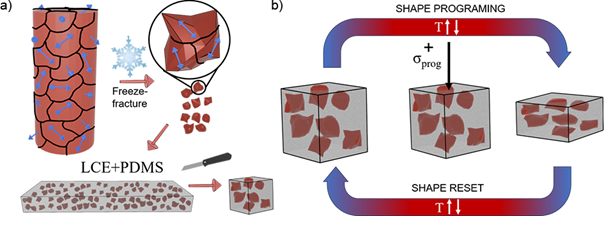
Mechanical anisotropy in compressive-stress shape-programmed liquid crystal elastomers and polymer-dispersed liquid crystal elastomer composites
Marta Lavrič, Luka Racman Knez and Andraž Rešetič, in collaboration with Valentina Domenici (Università degli studi di Pisa), have published an article entitled “Mechanical anisotropy in compressive-stress shape-programmed liquid crystal elastomers and polymer-dispersed liquid crystal elastomer composites” in the Nature Portfolio journal Soft Matter. This article provides insight into the mechanical properties of liquid crystal elastomers and polymer-dispersed liquid crystal elastomer (LCE) composites (PDLCEs) with a high-temperature persistent glass phase. It specifically focuses on compressive programming, which induces transverse mechanical anisotropy and a mesogen configuration with a negative order parameter. Directional stress–strain and thermomechanical tests reveal that, despite the elastic matrix, PDLCEs retain mechanical properties comparable to pure LCEs, highlighting the role of mechanical anisotropy together with inclusion alignment and geometry. The degree of mesogen ordering is evaluated in LCEs, while a modified Halpin–Tsai model captures the mechanical response of PDLCEs.
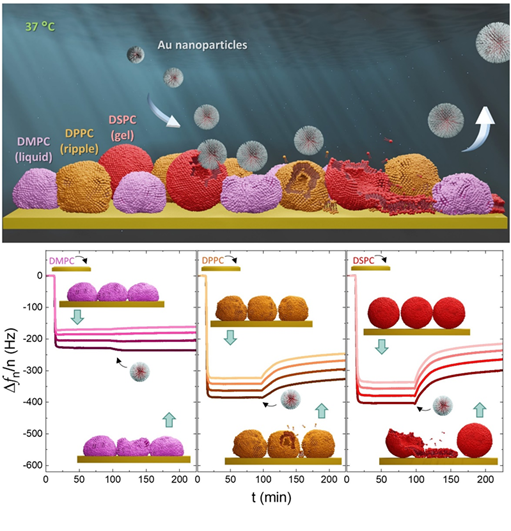
Lipid-phase-modulated interactions of gold nanoparticles with supported vesicular and planar membranes
Laure Bar, Marta Lavrič, Miha Škarabot, and George Cordoyiannis (F5), in collaboration with Maja Caf and Slavko Kralj (K8, Jožef Stefan Institute), Aleš Iglič (University of Ljubljana), Patricia Losada-Pérez (Université Libre de Bruxelles, Belgium), and Raj Kumar Sadhu (Indian Institute of Technology Kharagpur, India), have published an article entitled “Lipid-phase-modulated interactions of gold nanoparticles with supported vesicular and planar membranes” in Colloids and Surfaces B: Biointerfaces. This article provides new insights into the impact of lipid phase on interactions between lipid membranes and nanoparticles. Using quartz crystal microbalance with dissipation monitoring, complemented by atomic force microscopy and simulations, it demonstrates that vesicle rupture – induced by nanoparticles – is enhanced in rigid membranes (gel-ordered or ripple phase) compared to fluid (liquid-disordered phase) membranes. Importantly, the effect of lipid phase is decoupled from other physicochemical parameters, such as the lipid acyl chain length and the presence of charge in either the membrane or the nanoparticles. These findings establish lipid phase as a key determinant of nanoparticle-membrane interactions and advance fundamental understanding. This insight is essential, as dynamic changes in bilayer rigidity, composition, and surface charge regulate these interactions.
https://doi.org/10.1016/j.colsurfb.2026.115665