.svg)
Other news
Article in Nature Reviews Methods Primers
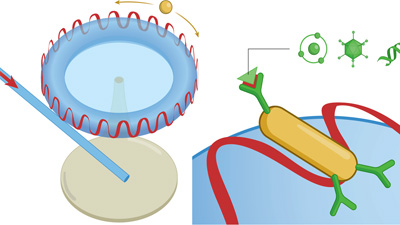
Doc. dr. Matjaž Humar from the Department of Condensed Matter Physics at Jožef Stefan Institute, and researchers from UK, USA and Japan have published an article titled Whispering-gallery-mode sensors for biological and physical sensing in Nature Reviews Methods Primers. In the paper the authors introduce whispering-gallery-mode microcavities in different geometries, such as microspheres, microtoroids, microcapillaries and microrings. Whispering-gallery-mode microcavities are miniature micro-interferometers that use the multiple-cavity passes of light for very sensitive measurements at the microscale and nanoscale, including single-molecule and ion measurements. The authors describe sensing mechanisms, including mode splitting and resonance shift, and optomechanical and optoplasmonic signal transductions. Applications and experimental results cover in-vivo and single-molecule sensing, gyroscopes and microcavity quantum electrodynamics.
Article in Physical Review X
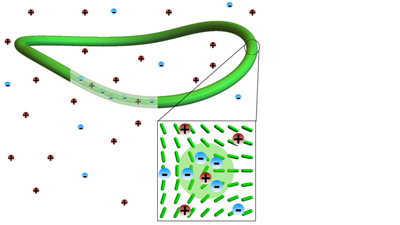
In an extensive study, Jeffrey C. Everts and Miha Ravnik from the Faculty of Mathematics and Physics at University of Ljubljana and the Department F5 of Jožef Stefan Institute examined the details of the coupling of ions and singular topological defects in complex nematic fluids (Phys. Rev. X 2021). The authors showed that topological defects in nematic electrolytes could perform as areas for local separation of electric charge, forming electrically charged cores of defect and in selected geometries also electrical multi-layers. These charge distribution are generalizations of electrical double layers known in isotropic electrolytes. In particular, they show that ions couple very efficiently with the defect cores through the mechanism of ionic solubility, and with the surrounding orientation field deformations through the mechanism of flexoelectricity. The work is a significant contribution towards understanding the electrostatic mechanisms in complex soft matter.