.svg)
News
Article in Nature Materials
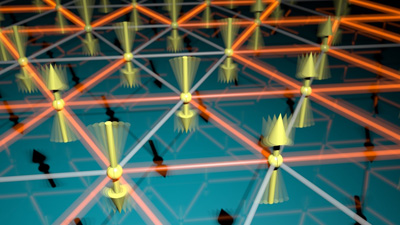
Associates of the Department of Condensed Matter Physics Tina Arh, Matej Pregelj, pHD, and prof. Andrej Zorko pHD, discovered the first realization of a quantum spin liquid on a Ising triangular-lattice antiferromagnet. They performed a large scale experimental study in collaboration with the researchers from the Slovenian Institute of Mathematics, Physics and Mechanics as well as researchers from India, Great Britain, France and the USA. The results were published in Nature Materials in the article The Ising triangular-lattice antiferromagnet neodymium heptatantalate as a quantum spin liquid candidate. In addition to being a significant scientific discovery, this discovery also has an important potential for the latest quantum technologies, as spin liquids are seen as one of the most perspective platforms in quantum computing.
Awards 2021
Dr Luka Drinovec and Prof Griša Močnik, PhD: The Puh Award for outstanding achievements in the development of methods for measuring aerosol absorption, Ljubljana, The Government of the Republic of Slovenia
Asst. Prof. Anton Gradišek: Award for the best oral presentation at Ecobalt 2021 with the title “Particle Removal Efficiency of Face Masks During the Covid-19 Pandemic”, Riga, Latvia (virtual)
Asst. Prof. Anton Gradišek: Team JSI vs COVID won 2nd place at XPRIZE Pandemic Response Challenge for finding best strategies against covid, Culver City, California, USA, XPRIZE Foundation (virtual)
Prof Miha Ravnik, PhD: The Blinc Award for physicists at the beginning of their career, Ljubljana, Faculty of Mathematics and Physics and Jožef Stefan Institute
Aljaž Kavčič, MSc. Phys.: The Prešeren Award for his master‘s thesis “Microscopy and sensing through scattering tissues using optical microresonators” (mentor Asst. Prof. Matjaž Humar), Ljubljana, University of Ljubljana
Prof Samo Kralj, PhD: Award for outstanding achievements in higher education, Ljubljana, The Council for Higher Education of the Republic of Slovenia
Asst. Prof. Uroš Tkalec: The Blinc Award for extraordinary one-time achievement in physics for a research in the field of imbalanced complex fluids that was published in Nature Communications, Ljubljana, Faculty of mathematics and physics and Jožef Stefan Institute
Article in Nature Reviews Methods Primers
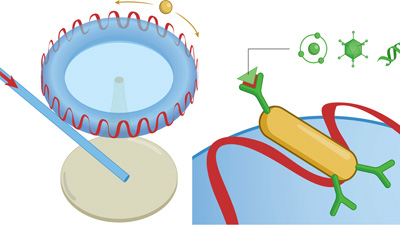
Doc. dr. Matjaž Humar from the Department of Condensed Matter Physics at Jožef Stefan Institute, and researchers from UK, USA and Japan have published an article titled Whispering-gallery-mode sensors for biological and physical sensing in Nature Reviews Methods Primers. In the paper the authors introduce whispering-gallery-mode microcavities in different geometries, such as microspheres, microtoroids, microcapillaries and microrings. Whispering-gallery-mode microcavities are miniature micro-interferometers that use the multiple-cavity passes of light for very sensitive measurements at the microscale and nanoscale, including single-molecule and ion measurements. The authors describe sensing mechanisms, including mode splitting and resonance shift, and optomechanical and optoplasmonic signal transductions. Applications and experimental results cover in-vivo and single-molecule sensing, gyroscopes and microcavity quantum electrodynamics.
Article in Physical Review X
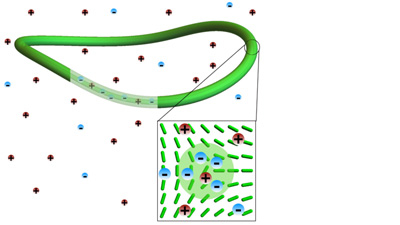
In an extensive study, Jeffrey C. Everts and Miha Ravnik from the Faculty of Mathematics and Physics at University of Ljubljana and the Department F5 of Jožef Stefan Institute examined the details of the coupling of ions and singular topological defects in complex nematic fluids (Phys. Rev. X 2021). The authors showed that topological defects in nematic electrolytes could perform as areas for local separation of electric charge, forming electrically charged cores of defect and in selected geometries also electrical multi-layers. These charge distribution are generalizations of electrical double layers known in isotropic electrolytes. In particular, they show that ions couple very efficiently with the defect cores through the mechanism of ionic solubility, and with the surrounding orientation field deformations through the mechanism of flexoelectricity. The work is a significant contribution towards understanding the electrostatic mechanisms in complex soft matter.

Article in Science Advances
The physical behavior of anisotropic charged colloidal particles in nematic solvents is determined by their dielectric anisotropy. Together with the experimental group of Professor Ivan Smalyukh at University of Colorado Boulder the authors Jeffrey C. Everts and Miha Ravnik from the Faculty of Mathematics and Physics at University of Ljubljana and the Department F5 of Jozef Stefan Institute demonstrated anisotropic electrostatic screening for charged colloidal particles in nematic electrolytes. The electrostatic potential and pair interactions decay with an anisotropic Debye screening length, contrasting constant screening length for isotropic electrolytes. Charged dumpling-shaped near-spherical colloidal particles in nematic media are used as model systems, demonstrating competing anisotropic elastic and electrostatic effective pair interactions for colloidal surface charges tunable from neutral to high, yielding particle-separated metastable states (Science Advances 2021, DOI: 10.1126/sciadv.abd0662). The work was published in Science Advances and contributes to the understanding of electrostatic screening in nematic media.