.svg)
News
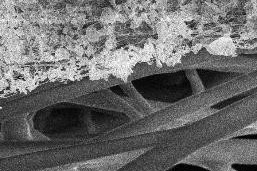
Additional funding to research protective mask materials
At the 2020 ARRS call for additional funding related to COVID-19, the research program “Physics of soft matter, surfaces and nanostructures” (P1-0099, coordinator Slobodan Žumer) was successful with the proposal “Study of materials for protective respiratory face masks” prepared by Maja Remškar and Miha Ravnik. The additional 2-year funding of 2700 working hours per year will support research at IJS (two thirds) & UL FMF (one third) and collaboration with Marjan Ješelnik from the company smartMELAMINE.
Review articles
1. Zvonko Trontelj, Janez Pirnat, Vojko Jazbinšek, Janko Lužnik, Stanko Srčič, Zoran Lavrič, Samo Beguš, Tomaž Apih, Veselko Žagar, Janez Seliger, “Nuclear Quadrupole Resonance (NQR): a useful spectroscopic tool in pharmacy for the study of polymorphism”, Crystals, 2020, 10, 6, 450.
2. Pedro Campinho, Andrej Vilfan, Julien Vermot, “Blood flow forces in shaping the vascular system: a focus on endothelial cell behavior”, Frontiers in physiology, 2020, 11, 552.
3. Ema Valentina Brovč, Janez Mravljak, Roman Šink, Stane Pajk, “Rational design to biologics development: the polysorbates point of view”, International journal of pharmaceutics, 2020, 581, 119285
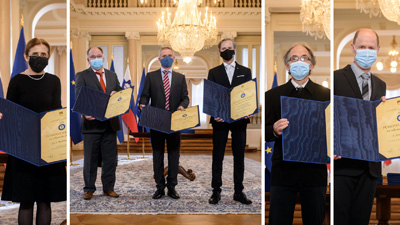
Prof. dr. Samo Kralj received Zois Certificate
This year’s winners of the Slovenian highest awards for science were presented on December 1, 2020, in a documentary Highlights of Slovenian Science through the eyes of award winners for outstanding achievements 2020. One of the award winners is prof. dr. Samo Kralj from the Condensed Matter Physics Department who received the Zois Certificate of Recognition for important research achievements in the field of soft matter physics. Congratulations!
Short articles
1. Slobodan Žumer, “Electroshock tuning of photonic crystals”, Nature materials, 2020, 19, 1, 6-7.
2. Žiga Snoj, Igor Serša, Urša Matičič, Erika Cvetko, Gregor Omejec, “Nerve fascicle depiction at MR microscopy and high-frequency US with anatomic verification”, Radiology, 2020, 297, 3, 672-674.
3. Francesca Serra, Uroš Tkalec, Teresa Lopez-Leon, “Editorial: topological soft matter”, In: Topological soft matter, (Frontiers research topics), Frontiers Media, 2020, 4-5.
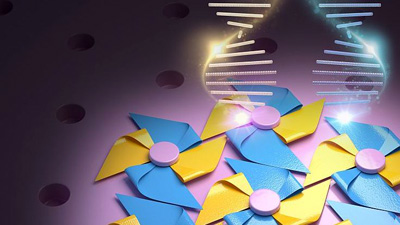
Article in Advanced Materials
Dr. Simon Čopar form the Faculty of Mathematics and Physics, University of Ljubljana, and dr. Uroš Tkalec from the Condensed Matter Physics Department at the »Jožef Stefan« Institute in collaboration with Korean researchers led by Dong Ki Yoon have published article Periodic Arrays of Chiral Domains Generated from the Self-Assembly of Micropatterned Achiral Lyotropic Chromonic Liquid Crystal in the ACS Central Science. The article includes both the experimental demonstration and theoretical explanation of the phenomena and is an important contribution towards practical use of chiral structure made from water-based non-chiral LC-molecules. It was highlighted on the front page of the November issue of the journal, which also included a commentary by Oleg Lavrentovich from Kent State University.