.svg)
Other news
Article in Sensors
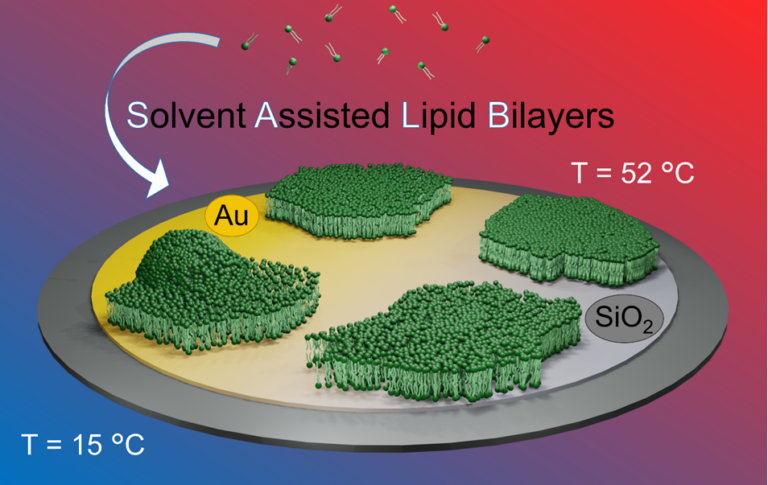
Colleagues from Condensed Matter Physics Department, Marta Lavrič, George Cordoyiannis in Nikola Novak, in collaboration with groups from University of Ljubljana (L. Bar, A. Iglič) and Université Libre de Bruxelles Bruslju (M. E. Villanueva, P. Losada-Pérez), have published an article in the journal Sensors, entitled “Quality assessment of solvent-assisted lipid bilayers in different phases and aqueous buffer media: A QCM-D study” (https://doi.org/10.3390/s24186093). By means of quartz microbalance with dissipation monitoring (QCM-D), they have measured the adsorbed lipid mass in real-time, through changes in frequency and dissipation. They have demonstrated how different experimental parameters (aqueous buffers, and adsorption at temperatures corresponding to the fluid or gel phases) affect the quality of supported lipid bilayers, formed by the solvent-exchange method on Au and SiO2 surfaces. This time-efficient method for forming supported lipid bilayers is recently receiving increasing attention among scientists. However, its dependence on different experimental conditions is not yet fully understood.
Article in Advanced Materials
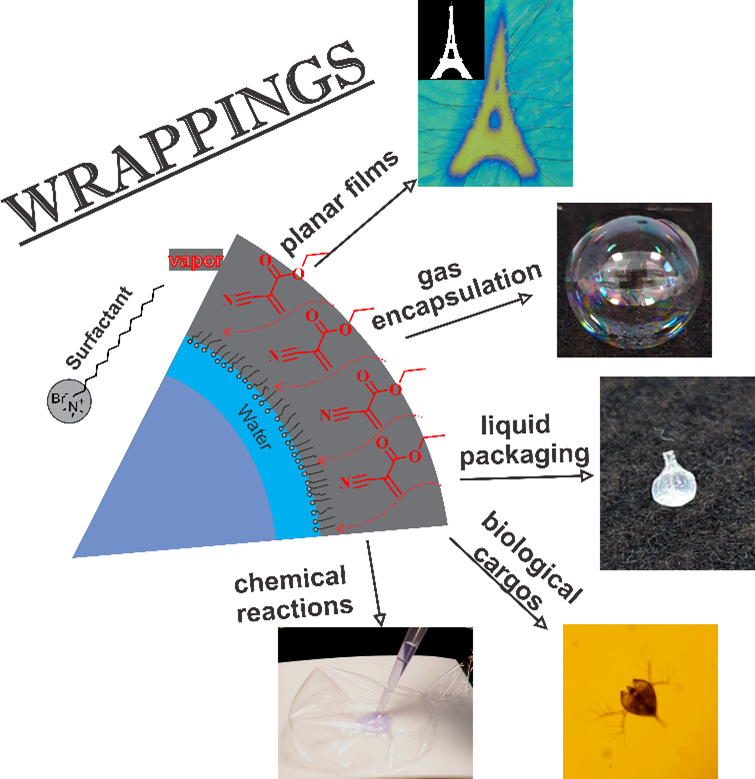
Our coworkers Venkata. S. R. Jampani, Miha Škarabot and Miha Ravnik in collaboration with the Faculty of Mathematics and Physics (Urban Mur), University of Luxembourg (Jan Lagerwal and Manos Anyfantakis), École Normale Supérieure, France (Damien Baigl), and the University of Siegen, Germany (Ulrich Jonas) reported the concept of WRAPPINGS (Water-based, Room temperature, Atmospheric Pressure Polymerization of INstant Glues controlled by Surfactants) in Advanced Materials.
Superglues (cyanoacrylate monomers) are well-known for their rapid reactivity, forming poly(cyanoacrylate) chains that bond materials instantly. However, using these biodegradable polymers in demanding applications is limited by the challenge of controlling their reactivity. This study introduces an eco-friendly technique that enables precise control of poly(cyanoacrylate) thin film properties by modulating the polymerization of superglue vapors on water surfaces containing surfactants. This approach facilitates the creation of water-templated films for gas encapsulation, liquid packaging, and in-situ chemical/biological cargo packaging.