.svg)
Other news
Strong enhancement of the electric breakdown strength in properly matched polymer blends
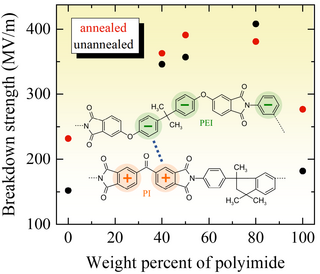
One of the major challenges in developing materials for energy storage systems is realizing high energy density while maintaining low dielectric losses. The composite approach, where conductive particles are dispersed in the dielectric matrix, effectively increases the dielectric permittivity but also boosts the losses. An alternative approach is an operation under high electric fields, i.e. increasing the electric breakdown strength (Eb) without increasing the dielectric permittivity.
Phenyl groups are fundamental chain components of many high-temperature polymers and, depending on the polymer's molecular structure, delocalized electrons in these groups may exhibit a partially positive or negative charge. We prepared blends of polyetherimide (PEI) and polyimide (PI) by the solution casting method and performed their extensive dielectric characterization. We demonstrated a significant enhancement of Eb in blends due to strong electrostatic interactions between different polymer chains; PEI namely contains three negatively charged phenyls, while PI has two strong positively charged phenyl groups. Electrostatic interactions (i) strongly reduce the number of space charges and (ii) lead to much higher chain packing density in blends. Since the breakdown is initiated by charges that are accelerated by an applied electric field in weak points, i.e. voids in the system, both features contribute to the enhancement of Eb. The blending of appropriately matched polymers thus turned out as an outstanding strategy for improving the dielectric properties of polymer systems.
Published in: Vida Jurečič, Nikola Novak, Lovro Fulanović, Vid Bobnar, Space charge contributions to the dielectric response and breakdown strength of high-temperature polyetherimide/polyimide blends, Macromolecules 56, 1097 (2023).
Article in Particle & Particle Systems Characterization
Abdelrahim Ibrahim Hassanien, PhD from the Department of Condensed Matter Physics F5 and colleagues from Germany have published in Particle & Particle Systems Characterization the article Neuronal-like Irregular Spiking Dynamics in Highly Volatile Memristive Intermediate-scale AgPt-Nanoparticle Assemblies.
Neuromorphic computing seeks functional materials capable of emulating brain-like dynamics to solve complex computational problems. Interestingly, the transport properties of memristive materials show feature that is closely oriented toward the behavior of artificial neurons. However, artificial neurons are rather rigid mathematical concepts than realistic projections of complex neuronal dynamics.
Neuroscience suggests that highly efficient information representation on the level of individual neurons relies on dynamical features such as excitatory and inhibitory contributions, irregularity of firing patterns, and temporal correlations. Here, a conductive atomic force microscopy approach is applied to probe the memristive dynamics of nanoscale assemblies of AgPt-nanoparticles at the stability border of the conducting state, where physical forces causing the formation and decay of filamentary structures appear to be balanced. This unveils a dynamic regime, where the memristive response is governed by irregular firing patterns. The significance of such a dynamical regime is motivated by close similarities to excitation and inhibition-governed behavior in biological neuronal systems, which is crucial to tune biological neuronal systems into a state most suitable for information representation and computation.