.svg)
Other news
Electrically and Geometrically Tunable Photon Pair Entanglement from Ferroelectric Nematic Liquid Crystal
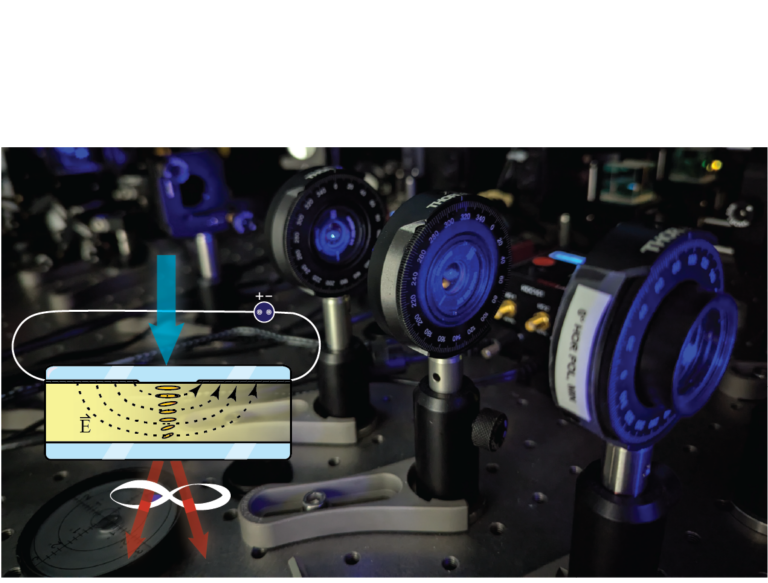
Entangled photons represent one of the key building blocks of modern quantum technologies. In our study Electrically and Geometrically Tunable Photon Pair Entanglement from Ferroelectric Nematic Liquid Crystal, published in Advanced Science, we demonstrated that quantumly entangled photon pairs can be generated in ferroelectric nematic liquid crystals (FNLCs), while simultaneously enabling continuous tuning of their degree of entanglement.
We showed that the thickness of the liquid crystal sample, in combination with the molecular twist, has a significant impact on the quantum state of the photons generated via spontaneous parametric down-conversion. By appropriately varying these two parameters, it is possible to transition from separable to fully entangled states (within the limits of experimental uncertainty). Furthermore, we demonstrated that the degree of entanglement can be dynamically controlled in real time using an external electric field, which influences the molecular orientation within the sample.
The ability to achieve fast and straightforward electrical control over molecular orientation—and consequently over the quantum state—constitutes a key advantage of liquid crystals compared to conventional solid-state nonlinear crystals. These results point toward the development of so-called “quantum displays,” in which each pixel would function as an independent, electronically controlled quantum light source.
S. Klopčič, A. Kavčič, N. Sebastián, and M. Humar, “ Electrically and Geometrically Tunable Photon Pair Entanglement from Ferroelectric Nematic Liquid Crystal.” Adv. Sci. (2025): e15206. https://doi.org/10.1002/advs.202515206.
The First Selective Detection of Respiratory Droplets in Air
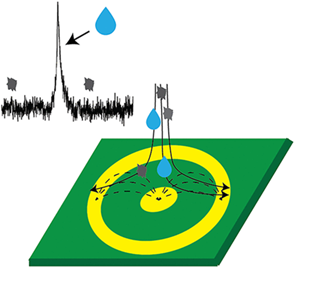
The transmission of infectious diseases via aerosols in the indoor air remains a major public health hazard. Infected people expel respiratory droplets through breathing, coughing and sneezing, which can remain airborne for hours and contribute to the spread of infections.
Researchers Matjaž Malok, Darko Kavšek and Prof. Maja Remškar from the Department of Condensed Matter Physics at The Jožef Stefan Institute have developed the first sensor based on an innovative method for detecting individual respiratory droplets in the air. The detection is selective without the influence of other air pollutants, unlike existing air quality meters that do not separate respiratory droplets from solid particles. The selectivity of the detection is based on the difference in dielectric constant between water and solid particles.
In addition to respiratory droplets, the sensor device is suitable for measuring particles with a high dielectric constant, such as TiO2, droplets of cooling lubricants in the metal industry and pollen in outdoor air. The use of these devices enables data-driven ventilation, energy savings, and highlights the need for infection prevention measures in hospitals, schools, gyms, and other public spaces.
The article is published in the journal ACS Sensors, https://doi.org/10.1021/acssensors.5c02057