.svg)
News
Nova objava: Z MXeni izboljšane piezoelektrične polimerne folije za fleksibilno elektroniko
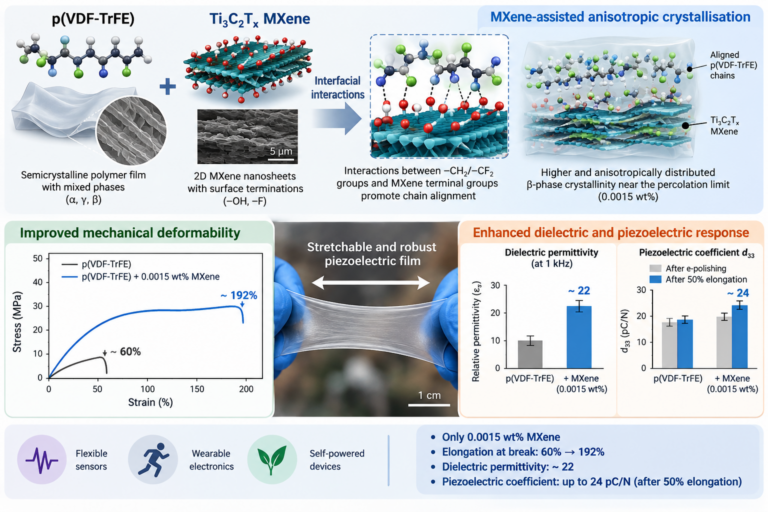
V naši najnovejši raziskavi, objavljeni v znanstveni reviji Polymers, smo pokazali, kako lahko že izjemno majhne količine dvodimenzionalnih MXene nanoplasti bistveno izboljšajo mehansko raztegljivost in piezoelektrične lastnosti polimernih folij. Rezultati odpirajo nove možnosti za razvoj fleksibilnih senzorjev, nosljive elektronike in naprav za pridobivanje električne energije iz mehanskih deformacij.
V raziskavi smo proučevali vpliv Ti₃C₂Tₓ MXene nanoplasti na strukturo in funkcionalne lastnosti polimernih folij iz poli(viniliden fluorid-trifluoroetilena), pripravljenih s sintezo iz raztopine in naknadno toplotno obdelavo. Ugotovili smo, da interakcije med površino MXene nanoplasti in polimernimi verigami spodbujajo njihovo usmerjeno razporejanje ter anizotropno kristalizacijo polimerne elektroaktivne β-faze, ki je ključna za učinkovito pretvorbo mehanskih deformacij v električne signale.
Pri optimalni koncentraciji MXena, ki znaša le 0,0015 masnega %, smo dosegli izrazito izboljšanje mehanske raztegljivosti. Raztezek ob pretrgu se je povečal s približno 60 % pri čisti polimerni foliji na kar 192 % pri nanokompozitu. Folije so izkazovale tudi izboljšane dielektrične lastnosti (dielektrična konstanta 22) in piezoelektrični koeficient d₃₃ do 24 pC/N po 50-odstotnem raztezku, ob ohranjeni strukturni celovitosti.
Objava: V. Kokol, B. Nečemer, E. Gibertini in V. Bobnar, Polymers 2026, 18, 2488.
Povezava do članka: https://doi.org/10.3390/polym18202488
Sara Klopčič prejela nagrado dr. Uroša Seljaka za najboljši znanstveni članek
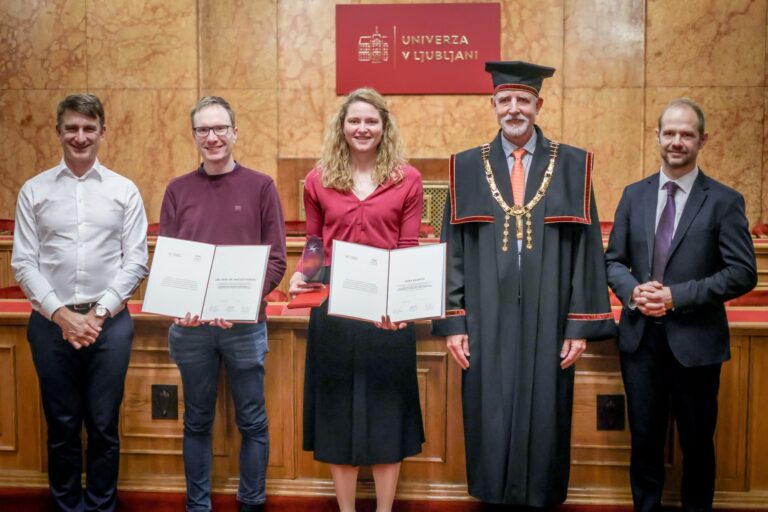
Na Univerzi v Ljubljani so 9. oktobra 2026 že petič podelili nagrade in pohvale dr. Uroša Seljaka za najboljše znanstvene članke študentk in študentov prve in druge stopnje študija v Sloveniji.
Med letošnjimi nagrajenci je tudi Sara Klopčič z Instituta »Jožef Stefan«, ki je nagrado prejela za znanstveni članek Electrically and Geometrically Tunable Photon Pair Entanglement from Ferroelectric Nematic Liquid Crystal (Električno in geometrijsko nastavljiva prepletenost parov fotonov iz feroelektričnega nematskega tekočega kristala).
Njen mentor, izr. prof. dr. Matjaž Humar z Odseka za fiziko trdne snovi Instituta »Jožef Stefan« in Fakultete za matematiko in fiziko Univerze v Ljubljani, je skupaj z nagrajenko prejel plaketo za mentorsko delo.
Nagrada dr. Uroša Seljaka spodbuja študentke in študente k znanstvenemu raziskovanju že med študijem ter poudarja pomen dobrega mentorstva pri doseganju izjemnih raziskovalnih rezultatov.
Article in Advanced Materials: Elasticity-Driven Periodic Polarization Patterns in a Chiral Ferroelectric Nematic Fluid
Marta Lavrič, in collaboration with a group from Department of Complex Matter F7 (A. Sterle, P. Medle Rupnik, L. Cmok, A. Erkoreka, N. Osterman, A. Mertelj, N. Sebastián) and research groups from University of Leeds (C. J. Gibb, J. Hobbs, R. J. Mandle) and University of the Basque Country (A. Erkoreka, J. Martinez-Perdiguero), has published an article entitled “Elasticity-Driven Periodic Polarization Patterns in a Chiral Ferroelectric Nematic Fluid” in Advanced Materials.
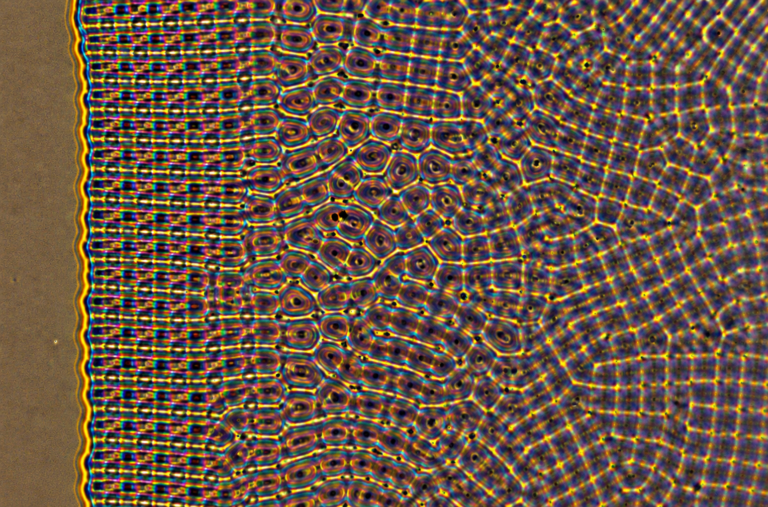
The interplay between chirality, confinement and elasticity can drive the spontaneous formation of complex polarization patterns in chiral ferroelectric nematic liquid crystals. These three factors work together to transform an initially uniform state into a variety of ordered structures.
In a new study the researchers show that when the pitch of the material under confinement deviates from its natural pitch, periodic instabilities emerge as the material approaches a heliconical polar state. Near such transition, the bend elastic constant of the liquid crystal softens. The combination of the material’s preferred helical structure, confinement and reduced resistance to bending drives the formation of periodic polarization patterns.
Under confinement, these instabilities give rise to a variety of self-organized structures, including stripes, squares and hexagonal patterns. By changing the thickness of the confined material and the surface alignment, the researchers can control which structures emerge.… Read the rest “Article in Advanced Materials: Elasticity-Driven Periodic Polarization Patterns in a Chiral Ferroelectric Nematic Fluid”
The effect of side chain length on the mesomorphic properties of ferroelectric nematogens
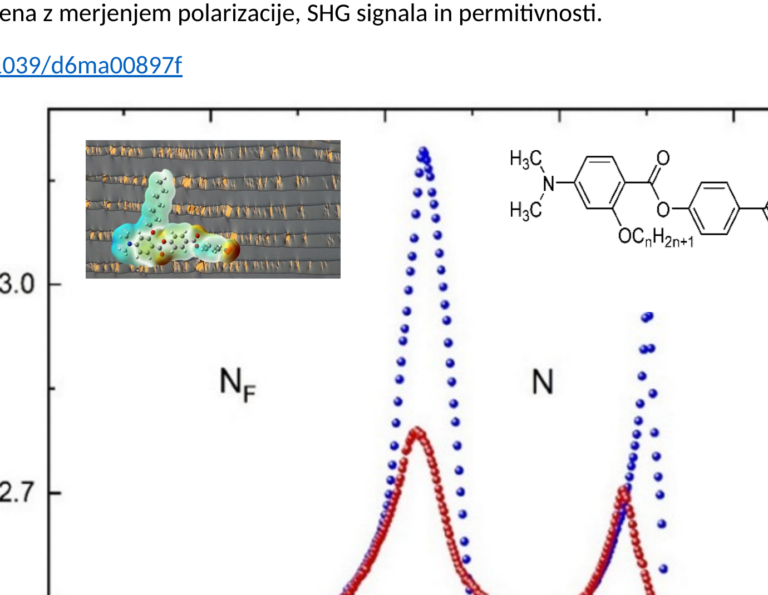
Marta Lavrič and George Cordoyiannis, in collaboration with coworkers from Complex Matter Department (A. Sterle, N. Sebastian, and A. Mertlej) and research groups from Czech Academy of Sciences (N. Podoliak, M. Cigl, P. Golub, V. Novotna) and University of the Basque Country (A. Erkoreka, J. Martinez-Perdiguero), have published an article entitled “The effect of side chain length on the mesomorphic properties of ferroelectric nematogens” in Materials Advances.
In this paper, a previously reported ferroelectric nematogen bearing a dimethylamino-terminated part was modified and explored. The effect of terminal group and molecular length on the mesomorphic properties was investigated in two new homologues. While previously reported shorter homologues exhibited a direct phase transition from the isotropic to the ferroelectric nematic phase, for prolonged alkyl chain a narrow nematic phase exists in-between. The mesomorphic and material properties of new compounds were established, and ferroelectricity was confirmed combining polarization, SHG signal and permittivity measurements.
DOI: 10.1039/d6ma00897f
The effect of fluorine or chlorine substitution on mesomorphic properties of ferroelectric nematic liquid crystals
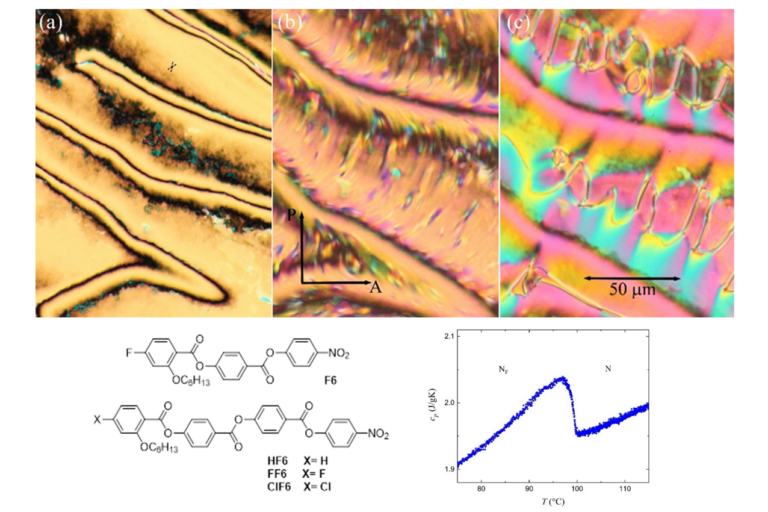
Marta Lavrič, in collaboration with a group from Prague (M. Cigl, N. Podoliak, D. Repček, P. Golub and V. Novotna), has published an article entitled “The effect of fluorine or chlorine substitution on mesomorphic properties of ferroelectric nematic liquid crystals” in Materials Advances.
Ferroelectric nematic phase (NF) represents an attractive and rapidly developing area of liquid crystals, combining fluidity with ferroelectricity. NF materials exhibit large polarization values and remarkable non-linear optical properties. In this article an original molecular structure, non-substituted and with halogen substituents in the position of an electron donating group was designed, taking into consideration that application of Cl atom has been utilized for the first time in the design of ferroelectric nematogens. For homologues with a prolonged molecular core, we observed the ferroelectric nematic phase (NF) below the nematic one during the cooling process. Moreover, for non-substituted homologue, the NF phase is enantiotropic in a broad temperature range. The presented results provide valuable insight into the design of ferroelectric nematic liquid crystalline compounds.
DOI: 10.1039/D6MA00129G